Wulong Fantasy: Where Transformers Meets a Karst Epic
Opening Impact: The Cinematic Downscaling
Imagine standing at the bottom of a 300-meter-deep natural sinkhole, looking up at three stone bridges spanning the sky—not man-made structures, but masterpieces sculpted by nature over 200 million years. This is the first impression Wulong's Three Natural Bridges delivers to every first-time visitor: a geological spectacle that transcends human scale.
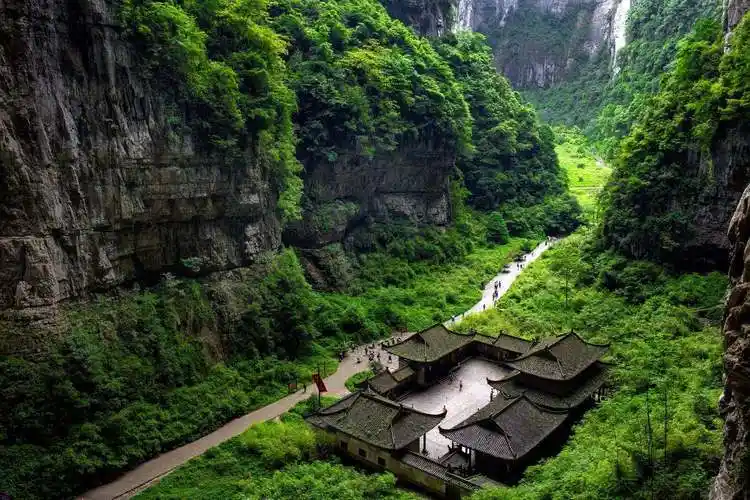
If you've seen Transformers: Age of Extinction, this scene will instantly trigger your visual memory. This is the backdrop where Optimus Prime battles the robotic dinosaurs. But the flat, 2D screen fails to convey the site's three-dimensional grandeur: the Three Natural Bridges—Tianlong Bridge (235m high), Qinglong Bridge (281m high), and Heilong Bridge (223m high)—form near-perfect geometric arches over two massive sinkholes, creating the wonder of "three bridges sandwiching two pits."
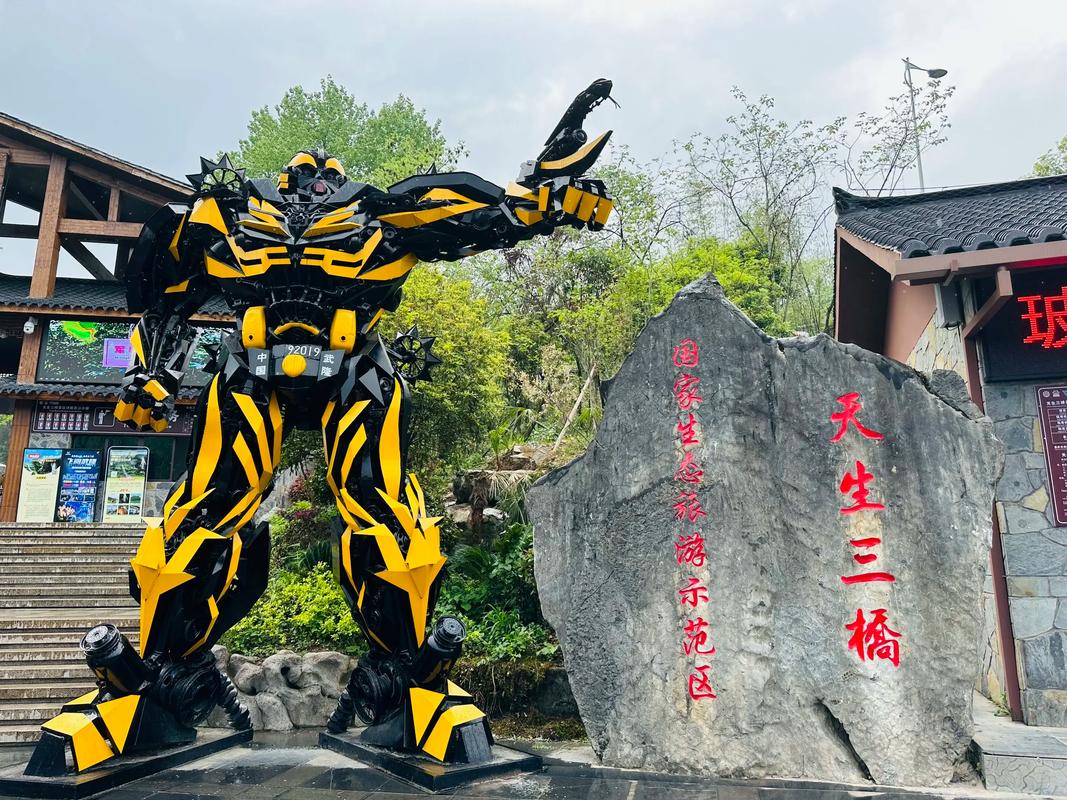
Standing beneath Tianlong Bridge, sunlight pours through the arch, forming beams of light. At your feet is the Tianfu Posthouse from the film Curse of the Golden Flower—a Tang-dynasty-style courier station that appears minuscule in the 300-meter-deep pit. This contrast creates a dual cognitive dissonance: the humility of human architecture before nature's creation, and the recoding of ancient geological landscapes by modern film.
For international visitors, two reference points help anchor this awe:
- Scale Conversion: The tallest bridge, Qinglong, is as high as a 90-story building; the pit floor is as large as 12 soccer fields.
- Time Compression: The landscape's formation spans from the age of dinosaurs to today.
Decoding the Geological Wonder: A Minimalist Guide to Karst
The geological term "karst" originates from Slovenia's Karst Plateau, but Wulong offers its most dramatic expression. To explain this to a global audience, avoid jargon and use familiar analogies instead:
Core Mechanism: Water + Limestone = Nature's 3D Printer
Picture a giant sponge cake (limestone layers) slowly dissolved by acidic rainwater (containing carbon dioxide). This happens through three key phases:
| Phase Analogy | Wulong Equivalent |
|---|---|
| Surface Dissolution | Spoon scooping holes on the cake's surface — Stone Forest, Dissolution Grooves |
| Subsurface Development | Spoon carving through multiple cake layers — Underground Rivers, Caves |
| Collapse & Formation | Large internal cavity causes the top to collapse — Sinkholes, Natural Bridges |
Wulong's uniqueness lies in its "three-layer cake" structure: the top is hard limestone (bridge body), the middle is softer shale (easily eroded), and the bottom is hard limestone again (pit floor). Groundwater preferentially erodes the middle layer, creating cavities. The upper rock bends under gravity, but parts with sufficient structural strength remain, forming "natural bridges."
Data Insights:
- Formation Time: Approximately 200 million years (Triassic to present)
- Erosion Rate: Average 0.1-0.3 mm per year (one-tenth the speed of human nail growth)
- Major Collapse: The last significant collapse occurred around 10,000 years ago (early Holocene)
This ultra-slow "geological sculpting" contrasts sharply with the momentary movie filming: 200 million years vs. a 2-hour shoot. Understanding this transforms the view from a static landscape into an ultra-slow-motion film measured in "geologic years."
Road Trip Details: Engineering-Grade Navigation from Chongqing
The 160 km journey from Chongqing to Wulong is a vertical journey from urban jungle to geological wonder. The optimal route follows dual objectives: efficiency + scenery.
Core Route: Chongqing Main City → G65 Baomao Expressway → Wulong Exit → Fairy Mountain Town → Three Natural Bridges Scenic Area
- Total Distance: 160 km
- Theoretical Time: 2 hours
- Practical Time: 2.5-3 hours (including mountain roads)
| Option | Route Features | Best For | Time | Cost |
|---|---|---|---|---|
| Expressway Only | Entire G65, 40% tunnels | Time-sensitive travelers | 2 hours | Low |
| Mixed Route | Expressway + Provincial Road S303 | Scenery-first travelers | 3 hours | Medium |
| Off-peak Strategy | Depart at 6 AM or after 2 PM | Crowd-averse travelers | 2.5 hours | Low |
Unmissable Scenic Stops:
- Wujiang Gallery Section (30 km from Wulong): The expressway runs alongside the Wujiang River. Multiple parking spots offer views of "emerald water against red cliffs."
- Fairy Mountain Town Entrance: Altitude rises sharply from 200m to 1200m, temperature drops 5-8°C (9-14°F), vegetation visibly changes.
- Three Natural Bridges Parking Lot: The final kilometer is a winding mountain road—drive carefully.
Vehicle & Driving Tips:
- Minimum Ground Clearance: ≥160mm recommended (sedans possible but caution needed)
- Power Requirement: 1.5T or 2.0L and above for continuous ascents
- Navigation Setup: Must download offline maps (search "Wulong Three Natural Bridges Scenic Area")
- Fuel Reserve: Fill up before entering the mountains; gas stations are scarce near the scenic area
Time Allocation Golden Ratio:
- Driving: 2.5 hours (40%)
- Scenic Area Visit: 4 hours (53%)
- Buffer Time: 0.5 hours (7%)
Deep Dive: A Geological Comparison Experiment
The Three Natural Bridges and Longshuixia Ground Fissure represent two extreme expressions of karst topography. Understanding their differences is key to a deeper experience:
| Three Natural Bridges System (Macro Scale) | Longshuixia Ground Fissure System (Micro Scale) | |
|---|---|---|
| Spatial Feature | Horizontally expansive, with bridges aligned linearly | Vertically deep, with fissures reaching 120m |
| Visual Focus | Upward-looking perspective (bridge bodies) | Downward-looking perspective (crevices) |
| Formation Mechanism | Residual collapse (what remains) | Fracture erosion (what was removed) |
| Experience Analogy | Walking into a colossal open-air amphitheater | Delving into Earth's capillaries |
| Time Budget | Priority | Alternative Logic |
|---|---|---|
| ≤4 hours | Three Natural Bridges | Maximize efficiency for the core sight |
| 5-6 hours | Bridges + Ground Fissure | Bridges + Fairy Mountain — Cover geological diversity |
| ≥7 hours | Bridges + Fissure + Fairy Mountain | In-depth photography at Bridges — Full-scape experience |
Scientific Photo Locations:
- Base of Tianlong Bridge: Wide-angle upward shot including the Tianfu Posthouse (movie scene)
- Mid-section of Qinglong Bridge: Telephoto lens to compress and highlight the bridge's curve
- Ground Fissure Entrance: Top-down shot with slow shutter speed to capture water flow
- 3-5 PM: Oblique sunlight creates "light saber" effects through the arches
Practical Advice: A Data-Driven Travel Algorithm
Best Time Windows:
- Optimal Scenery: Late September to early November (autumn foliage, less rain)
- Best for Photography: April (higher chance of mist) or October (softer light)
- Avoid Peaks: Chinese National Day Holiday (Oct 1-7), when visitor numbers triple
Equipment Priority List:
- Non-slip Shoes (pathways have a wetness factor of 0.3-0.5)
- Polarizing Filter (reduces water glare, increases saturation by ~30%)
- Lightweight Tripod (allowed for long-exposure waterfall shots)
- Altitude Adjustment: 500m altitude variation within the scenic area; mind the temperature difference
Ticket Booking Strategy:
- Book Online 1 Day in Advance: Saves about 45 minutes of queuing
- Combo Ticket Choice: The Three Bridges + Ground Fissure pass offers the best value
- Entry Time: 8:30 AM or 1:30 PM to avoid tour groups
Environmental Protection Guidelines:
- Drones Forbidden (interferes with geological monitoring equipment)
- Rock Collecting Forbidden (fine of 500 RMB per gram)
- Take All Trash Out (no bins within the scenic area)
Wulong's fantasy lies not in surrealism, but in a reality that surpasses imagination. When 200 million years of geological process overlap with a 2-hour movie shoot in the same space, you're not just seeing a landscape—you're witnessing time itself made tangible.
No comments yet