The Peak of the Three Gorges: The Poetic Apex of the Yangtze
Within the majestic panorama of China's Three Gorges on the Yangtze River, a geographical landmark transcends mere scenic value — the Peak of the Three Gorges. Perched atop Chijia Mountain in Fengjie County, Chongqing, at an altitude of 1,388 meters, it is the physical high point overlooking Qutang Gorge and the majestic Kuimen Gate.
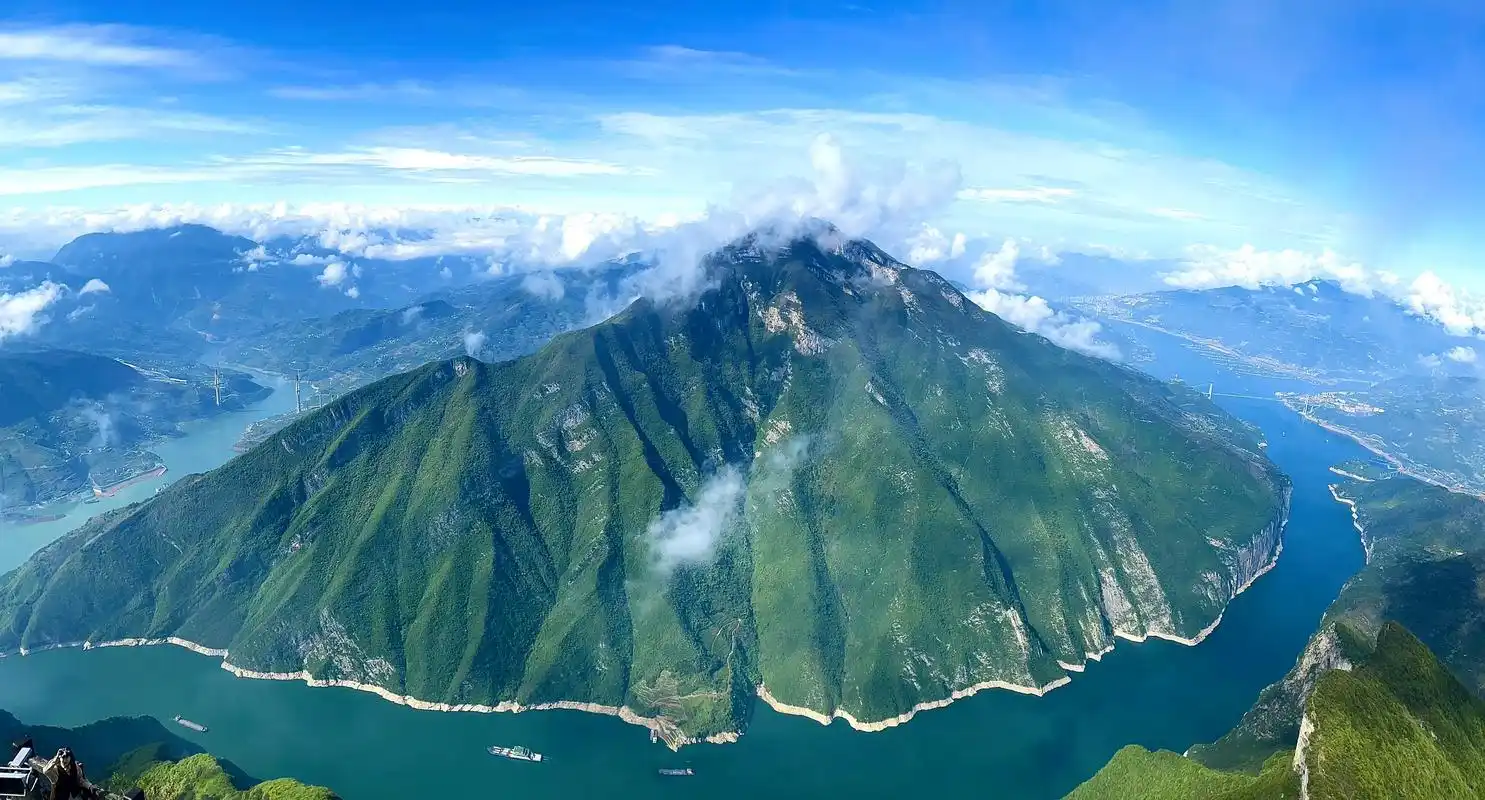
From a geological perspective, the Peak of the Three Gorges marks the highest point of the canyon system carved by the Yangtze as it cut through the Wu Mountains. Chijia Mountain, with its opposite Baiyan Mountain, together form the imposing "Kuimen — Tianxia's Mightiest Pass," a topographic feature immortalized on the back of China's 10-yuan banknote, making it one of the nation's most recognizable geographic symbols.
Geography and Historical Context: Millennial Echoes of a Poetry Capital
Fengjie, anciently known as Kuizhou, holds an irreplaceable position in the cultural system of the Yangtze civilization. As an administrative and cultural hub of the Three Gorges region, Fengjie was not merely a strategic transportation node but, more importantly, a "geographic generator" of classical Chinese poetry. This status stems from its unique location and profound historical accumulation.
Strategically, Chijia Mountain has long been a contested military stronghold. During the Three Kingdoms period, Liu Bei retreated to Baidi City (within present-day Fengjie), and Zhuge Liang set up his famous "Stone Sentinel Maze" here. These events imbued the land with rich layers of military history. However, Fengjie's deeper impact lies in the literary realm — it has been officially bestowed the title "China's City of Poetry", a distinction backed by concrete evidence.
The Tang Dynasty poet Du Fu composed over 430 poems during his residence in Kuizhou (modern Fengjie), accounting for a third of his extant works — a density rare in Chinese literary history. His poem "On the Height" captures the classic Three Gorges autumn scenery: "The boundless forest sheds its leaves shower by shower; / The endless river rolls its waves hour after hour." Another line, "Red Cliffs and Salt Range both impale the sky; / Where village lanes are coiled up mountain high," not only provides a literary basis for the name "Peak of the Three Gorges" but also precisely describes the geographical confrontation between Chijia Mountain (reddish) and Baiyan Mountain (whitish).
Dozens of other major poets in Chinese literary history, including Li Bai, Bai Juyi, and Su Shi, also passed through or ascended this land, leaving behind a vast corpus of verse. This collective literary phenomenon makes Fengjie a key case study for understanding the relationship between Chinese landscape poetry and geography. For international readers, comprehending the "City of Poetry" requires navigating two barriers: the loss of poetic essence in translation, and the cognitive gap regarding the ancient tradition of "traveling-officialdom" — where many poems were composed during official appointments, exiles, or travels.
Self-Drive Experience: The Engineered Path to Poetic Heights
For international visitors opting to drive, the transportation network to the Peak of the Three Gorges offers multiple access points. The most efficient route is the "High-Speed Rail + Tourist Shuttle" combination: take a high-speed train from Chongqing North Station to Fengjie Station (approx. 2 hours), then transfer to the "Fengjie Station — Baidi City — Peak of the Three Gorges — Wushan Airport" tourist shuttle. This service operates in the morning with an afternoon return. Tickets can be booked in advance via the "Yukexing" or "Fengjie Tourism" mini-programs.
For a full self-drive journey, set your navigation to either "The Peak of the Three Gorges Stone Temple Visitor Center (Cableway Station)" or "Blue Moon River Secondary Visitor Center (Sightseeing Bus Station)." Note that private vehicles are prohibited within the scenic area; all visitors must transfer to park-operated transport. Parking costs 10 RMB per entry, and capacity can be tight during peak seasons.
The journey showcases a distinct vertical distribution of scenery. Ascending from Fengjie town (approx. 200m altitude) to the Peak (1,388m), the winding road reveals shifting vegetation, transitioning from subtropical evergreen broadleaf forests to temperate coniferous-broadleaf mixed forests. Autumn (September–November) is the prime viewing season, when red and orange-yellow foliage bands appear stratified along the elevation gradient, and the probability of witnessing a sea of clouds is highest.
Self-Drive Tips
| Item | Recommendation |
|---|---|
| Vehicle | SUV or vehicles with high ground clearance to handle mountain road gradients |
| Navigation | Download offline maps, as mobile signals can be unstable in some mountainous sections |
| Timing | Avoid Chinese public holidays like National Day (Oct 1-7), when visitor numbers can surge by 300% |
| Weather | November is often foggy; cableway operations may be suspended — call the park for operational status before departure |
| Supplies | No commercial facilities within the park; bring water and snacks |
| Environment | Smoking and any open flames are prohibited; carry all trash out |
For shorter trips within the county, ride-hailing apps (Didi) are an option, but traffic on the 16-km mountain road between Baidi City and the Peak is sparse. It is advisable to arrange a return trip with the driver or keep their contact details.
Summit Options: A Decision Matrix of Efficiency vs. Depth
There are two main ways to reach the Peak of the Three Gorges, offering different time commitments and experiences:
Cableway Option (Stone Temple Main Entrance)
- Time Cost: Approx. 1.5 hours round trip
- Physical Demand: Low (suitable for families, elderly visitors)
- Cost Structure: Entrance fee + round-trip cableway 100 RMB (Off-season: 20 RMB entrance fee only, cableway extra)
- Experience: Vertical ascent, quick access to viewing platforms, ideal for photography-focused visitors
Hiking Option (Baidi City — Chijia Tower Entrance)
- Time Cost: 5-6 hours ("Precipitous Stone Bird Trail," 10 km)
- Physical Demand: High (requires anti-slip hiking boots, trekking poles)
- Cost Structure: Off-season combo ticket 100 RMB (includes one-way sightseeing bus down)
- Experience: Follows ancient historical paths, passes the steep "66 Hairpin Bends", offering an exploratory, archaeological quality
Key Restriction: The hiking entrance closes at 13:00; late arrivals cannot proceed. Visitors with knee concerns should opt for the cableway.
Cultural Connection: Translating Poetry for the Modern Traveler
The fusion of Du Fu's poetry with modern tourism at the Peak of the Three Gorges exemplifies a "geography-text" intertextual mechanism. The park achieves this connection through three methods:
- Spatial Annotation System: Bilingual (Chinese-English) poetry tablets at viewing platforms mark the precise vantage points described in poems like Du Fu's "On the Height." For instance, the spot corresponding to "The boundless forest sheds its leaves shower by shower" is precisely identified.
- Temporal Synchronization Experience: During autumn visits, the park provides a "Poetry Season Guide" correlating Du Fu's verses on autumn scenery with the current progression of fall foliage.
- Digital Augmented Reality (AR): Using the park's app, scanning specific landscapes overlays AR content showing Tang Dynasty-era water level comparisons and animated interpretations of Du Fu's poems.
At its core, this conversion strategy transforms abstract poetic sentiment into tangible spatial coordinates and temporal nodes, providing international visitors with an immersive cultural entry point that doesn't require prior expertise in Chinese poetry.
No comments yet